
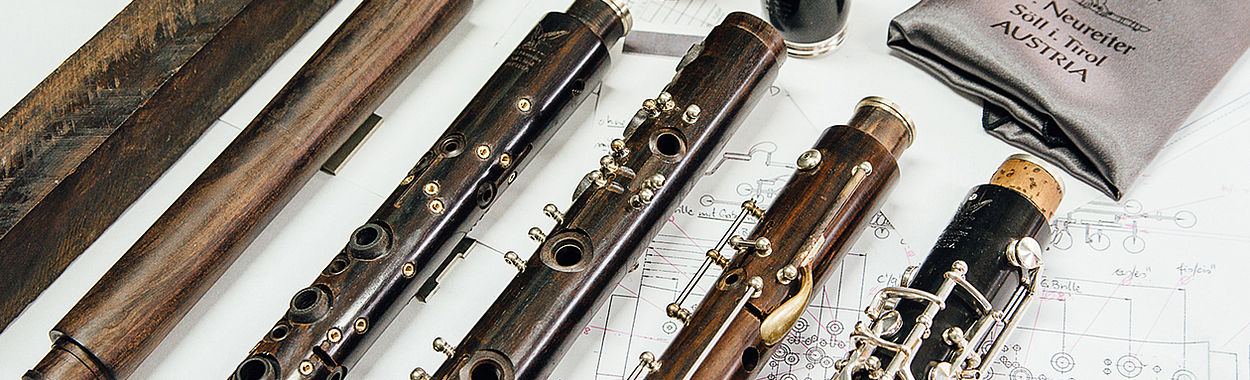
Types of wood
What kind of wood are you carved of?
Types of wood
Grenadilla
Found in: dry forests in Africa, Savanna tree
Characteristics:
- Very heavy (unrefined density: 1 – 1,2 g/cm³)
- Moderate shrinkage
- Good stamina
- Slow-drying
- Very slow water-absorbance
- Colour: purple to brown-black; often blue-black
- Fine graining and tier-like arrangement
- The most used type of wood for clarinet, oboes and wooden flutes – also in the industrial manufacture
Cocobolo
Found in: Central Amerika, pacific coastal area, North-Columbia to South-West-Mexico
Characteristics :
- Very heavy (unrefined density: 0,9 – 1,00 g/cm³)
- Moderate shrinkage
- Particularly slow water-absorbance and emission
- Good stamina
- Smoothed surface very dense and waxy smoothing
- Colour: orange-brown to purple-brown; often with a purple to black striping
- Very decorative
Cocus
Found in: West Indies; mainly in Cuba and Jamaica
Characteristics :
- Very heavy (unrefined density: 1,20 g/cm³)
- Moderate shrinkage
- Average stamina
- Slow-drying
- Very hard and compact
- Smooth and dense (hornlike) surface after grinding and polishing
- Graining particularly fine and dense
- Colour: grey-brown to olive-brown; later: intensive darkening
- Used only for high-quality woodwind instruments
- The word “Cocus” has nothing to do with the coconut tree. Its wood is totally different and not suitable.
Kingwood
Found in: North-east-Brazil
Characteristics :
- Heavy to very heavy (unrefined density: 0,90 – 1,10 g/cm³)
- Little shrinkage
- Very good stamina
- Very hard and compact
- Colour: natural purple-violet colouring; black to black-purple striped; gradually changes to a brown tone after being exposed to light and oxygen
Ebony
All types of wood mentioned above contain the chemical substance (Dalbergione) which is a contact allergen that can cause allergic reactions in sensitive individuals either through wood dust or direct contact. All types of ebony wood are exempted from this potential risk as they do not contain this substance. A selection:
- African Ebony (tropic West Africa, Ghana to Gabon)
- Indian Ebony (South India)
- Ceylon Ebony (Sri Lanka, South India)
- Papua Ebony (South-East Papua New Guinea)
Characteristics:
- Heavy to very heavy (unrefined density: 1,00 -1,10 g/cm³)
- Very hard and compact
- Little sensitive to moisture
- Colour: homogenously black; sometimes with grey-black or brown-black blurred zones which can produce a faintly striped or cloudy look
Caoutchouk Ebonite
Caoutchouc "Ebonite"
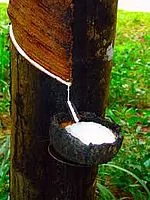
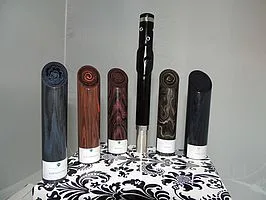
"Ebonite" is a 100% natural product.
For the production of this material, highly unsaturated caoutchoucs are required whose nuclear skeleton is more “compact” and therefore more solid due to their increased number of multiple compounds. Other reasons for the robustness of this material are the high heat resistance (up to 200°C) and the long production time (1 ½ days). This gives the raw material sufficient time to react with each other and we obtain a particularly high-quality product which is light, robust and very resistant against chemical attacks.
The 100% natural product from the caoutchouc tree was used in the manufacture of instruments mostly for high-quality clarinet and saxophone mouthpieces – we manufacture the whole body of it!
The positive characteristics of this material make a musician´s heart beat faster …
Sound characteristics :
- Immediate intonation
- Compact, clear, pure sound
- Strong sound volume
“Ebonite” is absolutely resistant against cracks, cold and heat, water-repellent and available in different colour shades.
We manufacture the following instruments from “Ebonite”: